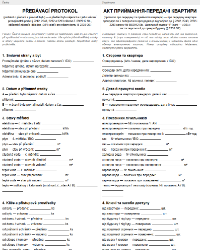
Flat handover record: what to write down when moving in and out so you get your deposit back
Meters, keys, furniture, defects and photos: what belongs in a handover record, in what condition the flat is returned and what the Civil Code says about normal wear and tear.
“That stain on the floor was already there when I moved in.” — “No, it wasn't.” Without evidence, such a dispute over the deposit cannot be won. A handover record with photos takes half an hour and saves thousands of crowns — for both sides.

1. Why the record matters
When the lease ends, the tenant returns the flat in the condition in which they took it over, apart from normal wear and tear from normal use and defects the landlord must remedy (Section 2293(1) of the Civil Code, Act No. 89/2012 Coll.). But what was the condition “at takeover”? The law expressly counts on a record: if a record describing the property was made at handover, it is taken into account when it is returned (Section 2225(1) OZ). The record is therefore the main evidence for tenant and landlord alike.
2. Moving in: what condition the flat must be in
The flat is made available once the tenant has received the keys and nothing prevents access (Section 2242(1) OZ). Unless the contract says otherwise, it must be fit to move into and live in — clean, in a condition usually regarded as good, and with essential services such as water, heating or electricity ensured (Section 2243 OZ). Write anything that falls short into the record on the day of handover.
3. What to put in the record
- Date, address of the flat, names and signatures of landlord and tenant; each keeps one copy.
- Keys: how many and for what (flat, building, mailbox, cellar), fobs and remotes.
- Electricity, gas, water and heat meter readings, including the meters' serial numbers.
- Room by room: walls, floors, windows, doors, switches and sockets — “no damage” is enough, or an exact description of the defect.
- Equipment (furniture, appliances): list, condition, brand if useful; whether it works.
- Existing defects (a crack, scratches, a faulty tap) — and whether and by when the landlord will fix them.
- A reference to photos and video taken that day (date in the file; ideally e-mail them to the other side).
4. During the lease: report defects straight away
The tenant carries out and pays only for routine maintenance and minor repairs connected with using the flat; everything else is up to the landlord (Section 2257 OZ). The landlord remedies a defect within a reasonable time after the tenant reports it. Beware: if the tenant does not report a defect without undue delay, they lose the right to reimbursement of costs and, if they fix it themselves, also to a rent reduction (Section 2265 OZ). So report defects in writing with a photo — then no one can claim at move-out that you caused them.
5. Moving out: the date, the keys, the condition
- The flat is handed back on the day the lease ends; it counts as returned once the landlord has the keys and nothing prevents access (Section 2292 OZ).
- If you do not hand it back on time, the landlord is entitled to compensation equal to the rent for each further day until actual return (Section 2295 OZ).
- Changes made with consent need to be removed only if you agreed so (Section 2293(2) OZ); changes made without consent must be removed unless the landlord says they do not require it (Section 2293(3) OZ).
- What you firmly built into walls or floors with the landlord's consent passes to the owner — and you can claim compensation no later than the day the lease ends (Section 2294 OZ).
- The landlord must look after belongings left in the flat at your expense; if you do not collect them even within an extra period, they may sell them after a warning (Section 2296 OZ).
- At return, draw up a second record as detailed as the move-in one and compare them point by point.
6. Normal wear and tear, or damage?
The law does not list what “normal wear and tear” is — what counts is what is usual with proper use over the given length of the lease. Normal wear usually includes, for example, slightly faded paint after several years or small marks from furniture on the floor. Damage, on the other hand, means a burnt worktop, broken tiles, or holes and stains from careless handling. Comparing the two records with photos shows exactly what is new.
7. And the deposit?
When the lease ends, the landlord returns the deposit (kauce) to the tenant, setting off only what the tenant owes under the lease; the tenant is also entitled to interest on the deposit at least at the statutory rate (Section 2254(2) OZ). If the landlord wants to keep part of the deposit for damage, they have to prove it — and the proof is, again, the two records. We cover the deposit in more detail in a separate article.