Landlord won't return your deposit: what to do step by step
What a landlord may deduct from the deposit, how to write a formal demand, late-payment interest, the electronic payment order and what court costs. Under the Czech Civil Code and Code of Civil Procedure.
You've handed the flat back and returned the keys — but no deposit. The landlord doesn't answer or promises “next month”. You are not powerless: the law says clearly what they may keep, and one well-written letter is often enough to get the money back.

1. What the landlord may keep
When the lease ends, the landlord returns the deposit, setting off only what the tenant owes under the lease (Section 2254(2) of the Civil Code, Act No. 89/2012 Coll.) — typically unpaid rent or proven damage to the flat. The tenant is not liable for normal wear and tear from normal use (Section 2293(1) OZ). Moreover, an uncertain or undetermined claim cannot be set off (Section 1987(2) OZ): a vague “the flat was ruined” is not enough — the landlord must say what, how much and why.
2. What about the service charges statement?
Actual costs of services (water, heating, lift…) are settled only after the billing period ends: the landlord must deliver the statement within 4 months of its end, and any overpayment or underpayment is settled within 4 months of delivery of the statement (Act No. 67/2013 Coll., Section 7(1) and (3)). That is why landlords sometimes keep part of the deposit until the statement arrives. The safest course is to agree in writing how much is kept and by when the statement will come — and get the rest of the deposit straight away.
3. A written demand to return the deposit
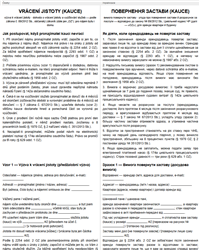
If the contract does not say when the deposit is returned, the creditor may demand performance at once and the debtor must then perform without undue delay (Section 1958(2) OZ). So the demand “starts the clock”. Send it in a way that lets you prove delivery — registered post with advice of delivery, to a data box (datová schránka), or by an e-mail the landlord replies to. Send it at least 7 days before filing a claim — otherwise the court will as a rule not award you the costs of proceedings (Section 142a of the Code of Civil Procedure).
- Who writes to whom: your name and address, the landlord's name and address, the flat's address and the contract date.
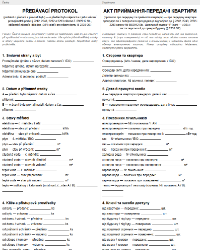
- When the lease ended and when you handed the flat back (refer to the handover record).
- The deposit amount and when and how you paid it.
- The amount claimed: deposit, interest on the deposit, minus anything you accept as owed.
- Account number and deadline for payment (e.g. 14 days from delivery).
- A warning that otherwise you will claim late-payment interest and go to court.
- Date and signature; keep a copy of the demand and proof of sending.
4. Late-payment interest
A debtor who does not pay properly and on time is in default (Section 1968 OZ), and the creditor may claim late-payment interest (Section 1970 OZ). Unless the contract sets another rate, it is, per year, the Czech National Bank repo rate valid on the first day of the calendar half-year in which the default began, plus 8 percentage points (Section 2 of Government Regulation No. 351/2013 Coll.). Note the difference: late-payment interest is not the same as interest on the deposit for the lease period, to which the tenant is always entitled (Section 2254(2) OZ). The flat CZK 1,200 recovery fee applies only between businesses (Section 3 of Government Regulation No. 351/2013 Coll.).
5. If the demand doesn't work: court
- Jurisdiction lies with the landlord's general court — for an individual, the district court (in Prague, the “obvodní” court) where they live (Sections 84 and 85 of the Code of Civil Procedure, Act No. 99/1963 Coll.).
- The fastest route is an electronic payment order: the application is filed on the Ministry of Justice's electronic form signed by the claimant (Section 174a OSŘ).
- Court fee for an electronic payment order: up to CZK 10,000 — CZK 400, up to CZK 20,000 — CZK 800, above CZK 20,000 — 4 % (Act No. 549/1991 Coll., fee schedule, item 2). For an ordinary claim: up to CZK 20,000 — CZK 1,000, above that 5 % (item 1).
- In a dispute up to CZK 10,000 (excluding accessories) no appeal is allowed against the judgment, except a judgment on admission or in default (Section 202(2) OSŘ).
- If you win, the court usually also awards the fee and other costs of proceedings.
6. Don't wait too long
The right to the deposit is subject to limitation: the period is three years (Section 629(1) OZ) and runs from the day the right could first be exercised (Section 619 OZ). After it expires, the debtor no longer has to pay (Section 609 OZ). So don't wait for “they'll send it eventually” — write as soon as the return deadline passes.