Bilingual lease agreement: is it valid and will the authorities accept it?
Can a lease be in Czech and English? What the Czech Civil Code says, which language version prevails and what authorities and courts require.
The landlord speaks Czech, the tenant English — and both want to understand what they are signing. A bilingual agreement is a solution the law allows. You only need to follow a few rules.

1. The parties choose the language
The Czech Civil Code (Act No. 89/2012 Coll., “OZ”) does not prescribe the language in which a lease must be written. Everyone may choose any form for a legal act unless limited by agreement or by law (Section 559 OZ). For the lease of a flat or house the law only requires written form (Section 2237 OZ). An agreement in Czech, in another language or in two languages side by side can therefore be valid if both parties conclude it in writing and sign it.
2. When the landlord is a business
If a company or sole trader lets a flat to a tenant who is a consumer, all communications must be made clearly and comprehensibly in the language in which the contract is concluded (Section 1811(1) OZ). With a bilingual agreement it is therefore advisable to send further documents — such as the service charge statement or a notice of termination — in the same languages.
3. Which version prevails
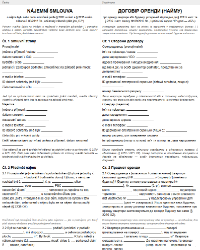
Two texts may differ in detail — no translation is perfect. The agreement should therefore state which language version is decisive in case of a discrepancy. In our contract and agreement templates (lease and sublease agreement, amendment, agreement to end the lease, acknowledgement of debt) it is always the Czech version: “This agreement is made in Czech and English; in case of any discrepancy, the Czech version prevails.” We also recommend the Czech version because Czech authorities and courts work with it.
4. Authorities work with the Czech text
In administrative proceedings — for example when applying for a long-term residence permit at the Ministry of the Interior — proceedings are conducted and documents drawn up in Czech; documents may also be submitted in Slovak (Section 16(1) of the Administrative Procedure Code, Act No. 500/2004 Coll.). A document drawn up in a foreign language must be submitted in the original together with an officially certified translation into Czech, unless the authority states that it does not require one (Section 16(2)). A bilingual agreement contains the full Czech text. For some proceedings under the Act on the Residence of Foreign Nationals, such as visa proceedings, this part of the Administrative Procedure Code does not apply (Section 168(1) of Act No. 326/1999 Coll.). Whether the authority will require anything further in a particular case is up to the authority — if in doubt, ask in advance.
5. Court: the right to your mother tongue
Should a dispute arise, the parties have the right to address the court in their mother tongue, and the court appoints an interpreter as soon as the need becomes apparent (Section 18 of the Code of Civil Procedure, Act No. 99/1963 Coll.). An agreement that both parties understand, however, tends to prevent disputes.
6. Practical tips
- Sign only once both parties have read the agreement and understand it.
- Keep both language versions side by side in one document — so there is no doubt that these are two different contracts.
- Each party receives one signed copy.
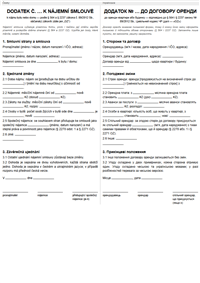
- Make changes (new rent, extension, additional occupants) by a written amendment in the same languages.
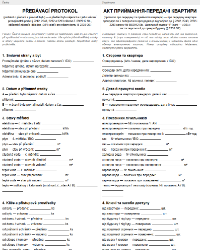
- Ideally use the same bilingual form for the handover report, termination and other lease documents.